
/ philosophy
Open Civics is the worldview of a participatory civilization
Open Civics is based on a shared worldview that the well being of people, place and planet depends on taking care of common resources, systems, and communities together. The core idea is simple: we create and build civilization together. It highlights our responsibility to support each other and explains the design philosophy behind the practice of open civic innovation.
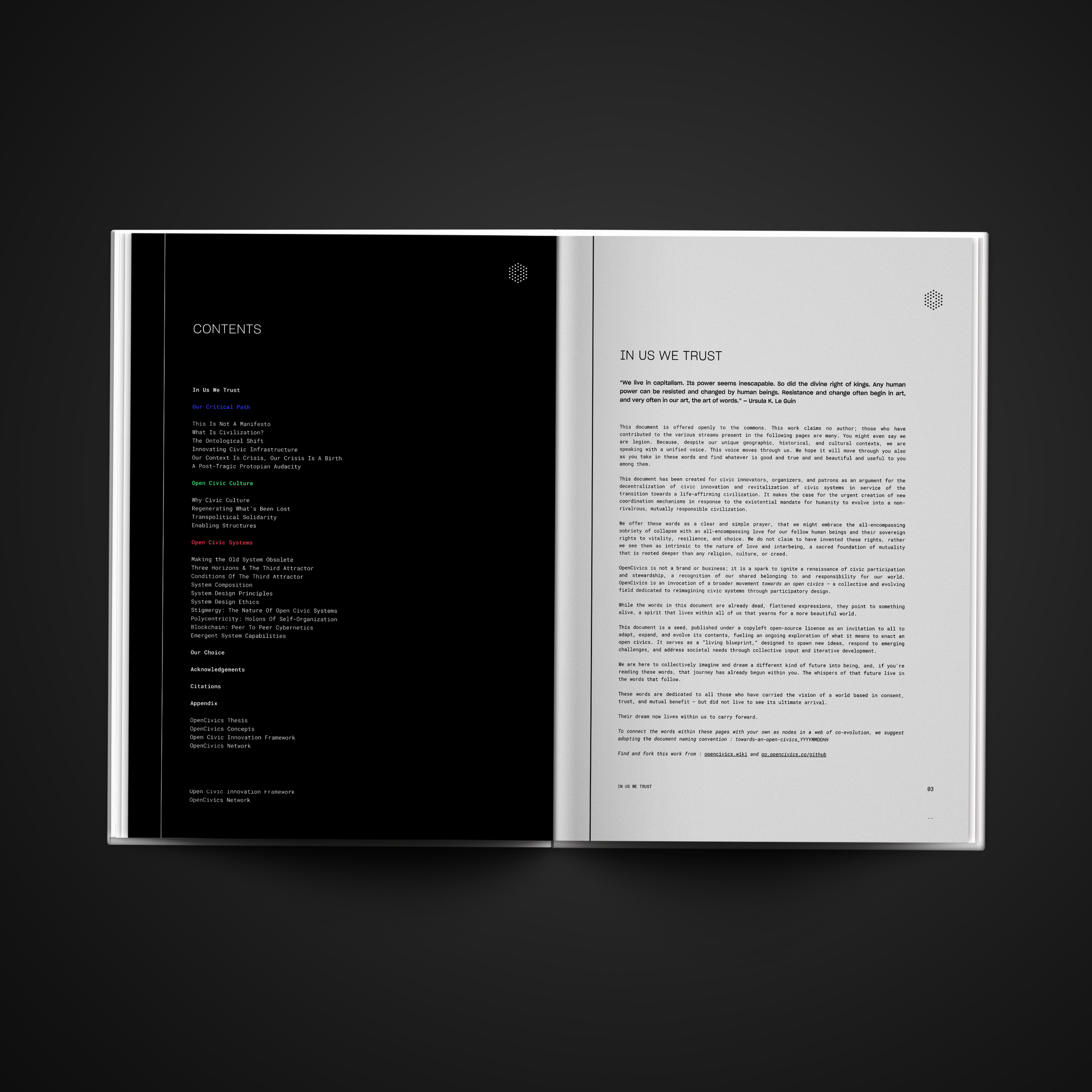
Contents
/ Thesis
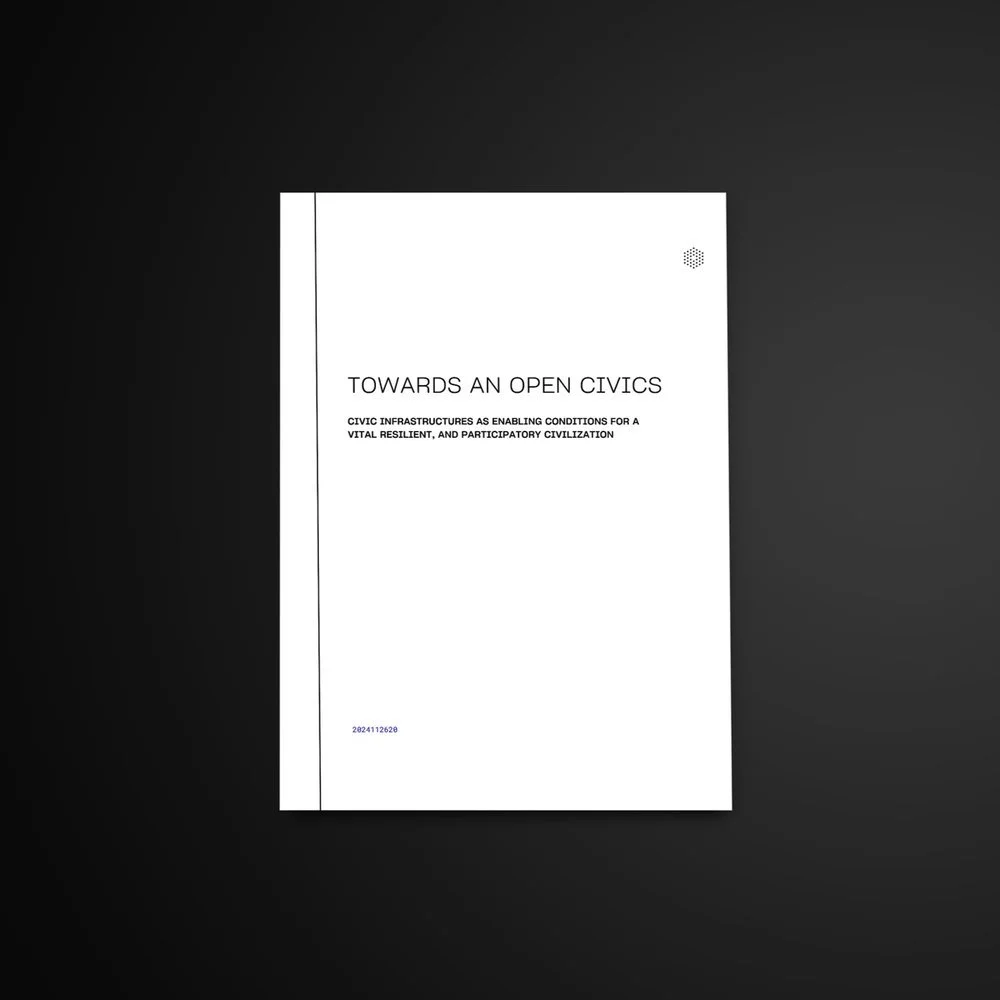
Towards an Open Civics
The orienting idea — what Open Civics is and what it proposes. The OpenCivics Thesis exists to articulate the systemic failures and challenges of contemporary civilization while proposing a transformative vision for a collaborative and resilient future.
-

Chapter 1: In Us We Trust
A seed offered to the commons—not a manifesto, but an invitation to collectively reimagine civic systems through participatory design.
-
Chapter 2: What is a Civilization
Civilization as collective agreement — infrastructures, incentives, and institutions that can be transformed, not fixed features of reality.
-
Chapter 3: The Ontological Shift
From separation to interbeing — the fundamental worldview transformation required to move from extraction to mutual responsibility.
-

Chapter 4: Civic Innovation & Open Civics
Reclaiming civics as stewardship, introducing open protocols and the health indicators of Vitality, Choice, and Resilience.
-

Chapter 5: Our Crisis is a Birth
Confronting the meta-crisis as coordination failure — converging existential risks driven by self-reinforcing feedback loops.
-
Chapter 6: The Three Attractors
Mapping probable futures: chaos, authoritarianism, or distributed coordination — humanity's narrow path through the eye of the needle.
READ → -
Chapter 7: A Post-Tragic Protopian Audacity
Holding grief and possibility simultaneously — imagination activism as rebellion against the myth that no alternatives exist.
READ → -

Chapter 8: Open Civic Culture
Civic renaissance as precursor to systemic change—transpolitical solidarity, regenerated social fabric, and enabling structures for self-organization.
READ → -

Chapter 9: Open Civic Systems — Architecture & Transformation
Transforming institutions into extitutions, extractive incentives into prosocial ones, fragmented infrastructure into networked open protocols.
READ → -

Chapter 10: Open Civic Systems — Design Principles & Living Systems
Stigmergy, polycentricity, and peer-to-peer cybernetics — designing human coordination in alignment with living systems principles.
READ → -
Chapter 11: Our Choice
An invitation to agency—building parallel systems grounded in love, care, and mutuality as civilization transitions between orders.
READ → (Dropping soon)
/ Core Beliefs
Our common First Principles
Interbeing and Mutual Interdependence
Open civics fundamentally rejects the atomistic, individualistic ontology of current civilization. Instead, it posits that reality is characterized by radical interdependence - that individual wellbeing is inseparable from collective and ecological wellbeing. This isn't just a moral position but an ontological claim about the nature of existence itself. Care and empathy, in this context, become an expression of rational self-interest.
Living Systems Principles as design Fundamentals
Open civics claims that human systems should align with the patterns found in living systems - including stigmergy, polycentricity, and evolutionary adaptation. This suggests an ontology where human civilization is understood as part of, not separate from, natural systems. Designing based on living systems principles compels us to design for reproducible protocols and DNA that can evolve organically through participation.
Civilization as Emergent Collective Agreement
Open civics views civilization not as a fixed structure but as a continuously reproduced set of collective agreements about how to organize society. These agreements shape our civic systems, which in turn shape what behaviors and outcomes are possible. To honor the consent of the governed, open civics sees participatory design ethics as intrinsic to the implementation of healthy systems of governance and coordination.
/ Theory of Change
An open civic roadmap to a world that works for it all
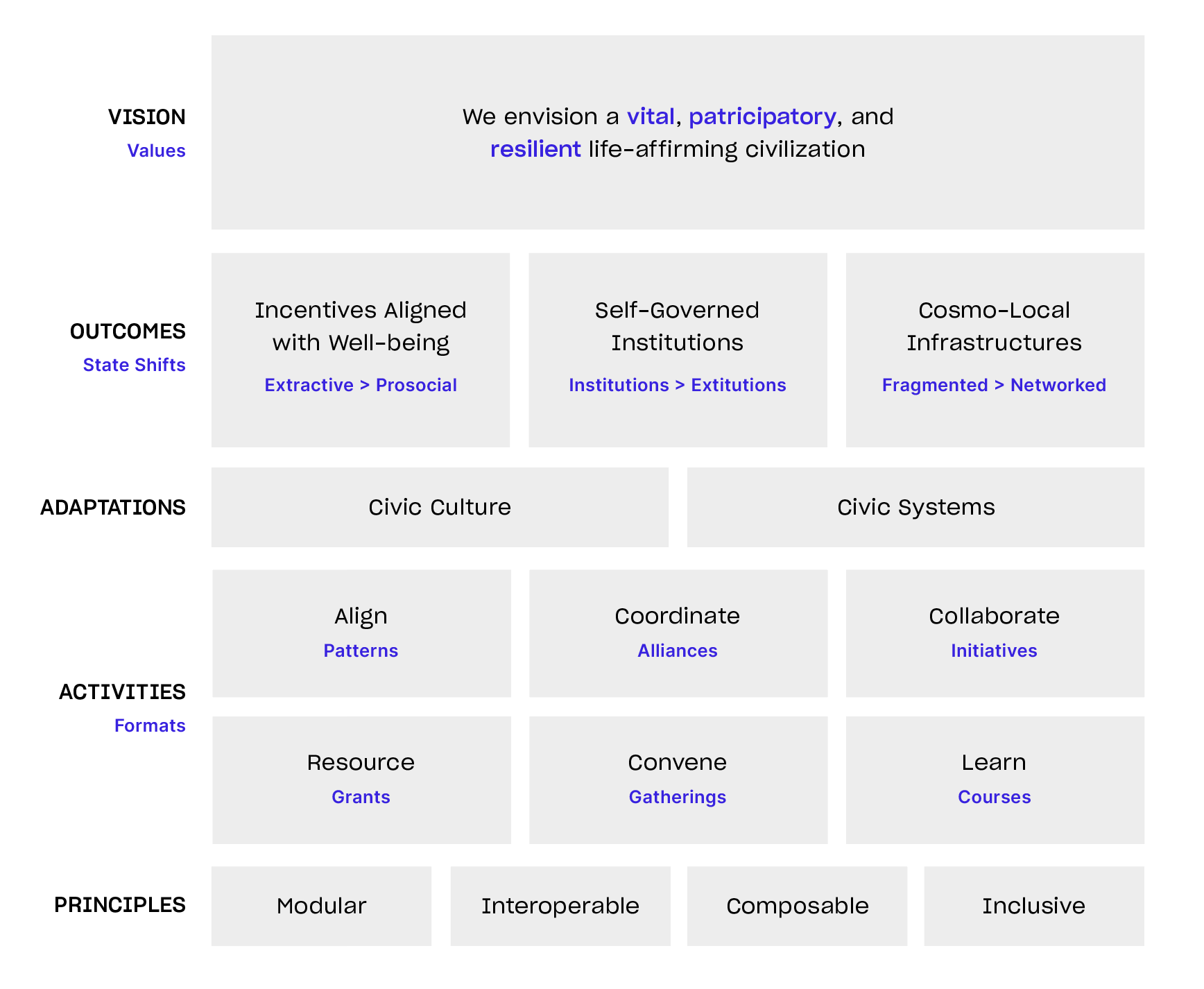
The theory of change explains why Open Civics is necessary now and how transformation unfolds. It defines a long-term vision of a vital, resilient, and participatory civilization and then maps our work backward to identify the necessary preconditions that would give rise to that future systemic equilibrium.
/ Core Concepts
COnceptual building blocks
These core concepts are intended to evolve as the emerging philosophy and field matures into an established discipline.
Foundations
-
Open civic culture represents a fundamental ontological shift from fragmentation and separation to interbeing and mutual interdependence. It embodies the renewal of civic virtue — the personal expression of taking responsibility for the maintenance and embodiment of systems of care.
Cultural Capacities
Transpolitical Solidarity: Open civic culture transcends divisive political ideologies by focusing on material conditions of life and emphasizing creativity and experimentation over regulatory control. It roots into place-based mutual solidarity while promoting pluralism and consent regarding diverse strategies communities might employ.
Regenerative Orientation: This culture actively works to regenerate what has been lost — our social fabric, ecological health, and sense of mutual belonging. It operates through the lens of bioregionalism, recognizing our mutual belonging to the places, watersheds, and biosphere we call home.
Participatory Engagement: Open civic culture empowers people to move from passive citizen-subjects and consumers into active citizen-participants and stewards. It creates safe spaces for children and future generations while valuing intact ecologies and recognizing the human need for connection, dignity, and purpose.
-
Open civic systems are dynamic frameworks that embody the interconnectedness of living systems, fostering stigmergic self-organization and adaptive co-creation. They serve as structural backbones for participatory, vital, and resilient societies by offering flexible frameworks for communities to align and innovate on shared solutions.
Open Civic Systems are the fruits of open civic innovation: every instance is a prototype that generates learning to be shared back into culture.
Key Transformations
From Institutions to Extitutions
Traditional bureaucratic institutions are transformed into frameworks for self-organization that provision the same services through participatory coordination mechanisms. Extitutions rely on open protocols rather than enclosure to coordinate essential services through webs of relationships.
From Extractive to Prosocial Incentives
Economic systems shift to align positive feedback with holistic markers of wellbeing. Prosocial incentives reward contributions to commons and markets that produce holistic well-being and mutual thriving, rather than extraction and enclosure.
From Fragmented to Networked Infrastructure
Infrastructure evolves from physical substrates to conceptual frameworks for coordination. Open protocols become the DNA of social organisms, providing non-enclosable patterns of human self-organization that can be modified and adapted like genetic code.
Design Principles
Modular: Systems divided into separate, self-contained units that can function independently or be combined
Composable: Components can be modified and configured to meet specific local needs
Interoperable: Different systems can work together seamlessly regardless of underlying technologies
Inclusive: Accessible and usable by all individuals, promoting equity and participatory engagement
-
A civic utility is a foundational public good that enables collective stewardship.
These utilities are collaboratively developed through open civic innovation and are designed to be modular, interoperable, and shareable. They function as essential building blocks—such as identity, coordination, and resource-sharing tools —that communities use to strengthen governance, social care, and commons stewardship. They are any co-created tool, protocol, or system that can be shared globally and implemented locally.
-
Open Civic Innovation is both a field and a practice — a way of treating civic life as something that can be consciously designed through commons-based experimentation rather than top-down planning. It restores and renews the spirit of collective responsibility for our commons by cultivating new mechanisms of civic stewardship rooted in participatory design.
When legacy institutions fail to meet the needs of holistic well-being and shared stewardship, civic innovators, organizers, and patrons step forward to create the enabling conditions for participation.
At its heart, Open Civic Innovation carries a simple ethos:
Start where you are. Build what you need. Share what you learn.
These three behaviours make open civic innovation accessible to all, ensure that learning flows across networks, and keep the practice grounded in lived realities.
-
Modular → Build in small, independent units that can combine flexibly.
Interoperable → Ensure systems and tools can connect and exchange seamlessly.
Composable → Enable components to be assembled in diverse ways to meet local needs.
Inclusive → Design for universal access and participation, across contexts and identities.
-
Personal ethics refer to behavioral and cultural patterns of members. Members are encouraged to regularly engage in open and heart-felt self-and-peer reflection on their ethical practice. Read
System design ethics refers to the ethical considerations for the practice of civic innovation. Members are encouraged to regularly engage in open and heart-felt self-and-peer reflection on their systemic design ethics.
Deeper Dives
-
The interconnected and overlapping global crises that collectively threaten the stability and sustainability of our world. It encompasses a wide range of issues, including ecological collapse, economic instability, social inequality, and political dysfunction. At its core, the meta-crisis highlights our systemic inability to address these challenges effectively due to underlying flaws in our perception, understanding, and governance structures. This concept urges us to recognize the interconnected nature of these crises and to seek holistic, integrative solutions that address the root causes rather than just the symptoms.
-
A system or structure that has multiple centers of control, authority, or importance. In a polycentric system, power and decision-making are distributed among several distinct entities or locations, rather than being centralized in a single point. This concept can apply to various contexts, such as governance, urban development, and organizational management.
-
Open civics views plurality as the fundamental acceptance and coexistence of diverse groups, principles, and sources of authority within society, where different cultural, religious, ethnic, and political groups maintain their unique identities while contributing to the broader community through bottom-up positive sum collaboration rather than rivalrous competition for centralized control.
-
Within the open civics philosophy, subsidiarity means that social and political issues should be addressed at the most immediate or local level consistent with their resolution, increasing opportunities for direct citizen participation in public affairs and creating distributed counterweights to centralized government power through the accumulation of local, active freedoms.
-
(Kostakis/Ramos) Design globally, make locally — open designs shared in the commons, locally adapted and manufactured to fit context. Within the open civics framework, cosmolocal production refers to the dynamic interplay between global coordination and hyperlocal participation, where design patterns and knowledge are shared globally while implementation, adaptation, and production happen at the most local scale possible, allowing communities to self-determine solutions while benefiting from planetary-scale learning and pattern sharing.
-
Stigmergy is a type of swarm intelligence in which individual agents, taking their own actions, signal those actions to other agents in such a way that other agents can contribute in a positive sum feedback loop. Examples of stigmergy in non-human organisms include ants, termites, bees, flocks of birds, bacteria, and slime mold. In humans, we can see examples of stigmergy in Burning Man, open source software development, Wikipedia, the Occupy movement, and various internet experiments.
Read more in wiki -
Protocols serve as detailed guidelines or frameworks that outline specific steps to be followed to achieve desired outcomes. Open protocols are specific types of public goods that establish infrastructure for open civic systems.
Protocols usually include:
Objective: The purpose and goal of the protocol
Scope: What's included and excluded in the protocol
Procedures: Step by step instructions to achieve the objective
Roles and responsibilities: Who is responsible for each action within the procedures
Materials and equipment: What’s required to carry out the procedures
Guidelines: Suggested considerations while conducting procedures
Documentation: Suggestions on how to document the outcomes of the procedures
Open protocols are a subset of protocols that are openly documented and freely available for anyone to use, implement, and modify. They are developed and maintained through collaborative, transparent processes, often involving multiple stakeholders.
Open protocols related to self-organizing systems are categorized according to their function. These categories include membership thresholds, membranes (circles and sub-circles), decision-making, sense-making, resource allocation, coordination and collaboration, learning, and culture.
Read more in wiki
/ Praxis
From theory to Practice
Praxis is the applied practice of our philosophy as we work towards creating and building a world that works for all.